Monday, 8 June 2015

7 'MUST-VISIT' PLACES AROUND PUNE DURING THE RAINS!

By Jayesh Paranjape

With the monsoon setting in, the Sahyadris surrounding Pune change colour and convert to a green haven. Hit any road going out of the city and within 20 minutes you are in paradise – lush green forest patches, waterfalls, rice fields and foggy & misty ghats. 


Photos: Vidyuth Singh
Here is our list of 7 'Must-Visit' Places Around Pune During the Rains. These destinations are perfect for a Sunday drive, a monsoon trek or probably a whole weekend away from the city! 

1. MULSHI


The Mulshi Lake | Photo: Vidyuth Singh
Just 40 km on the west of Pune, Mulshi is perfect to spend a rainy day with friends and family, eating kanda bhajis, bhutta and sipping on masala chaai. To reach Mulshi, from Pune, just take the road from Chandani Chowk via Pirangut, Paud and continue on the Mulshi Dam Road. The area is surrounded by the rugged mountains and forests of the Sahyadris and during and post monsoons, the area becomes lush green. Personally, the most striking feature of the area during the monsoons, are the numerous small and big waterfalls along the road. The Mulshi Lake in all its grandeur is visible throughout the road journey. During weekends, the area gets crowded, so the best way is to park your vehicle on the road and just walk your way to the lake and explore a new place. 

Mula River downstream from the Mulshi Dam | Photos: Vidyuth Singh

2. TAMHINI GHAT


The Kundalika Valley at Tamhini Ghat | Photo: Dhananjay Kulkarni
If you keep driving beyond the Mulshi Dam, you would pass through Tamhini Ghat. This road further meets the NH-17 (Bombay-Goa Highway) at Mangaon. The drive is through extremely dense and rich forest areas and plenty of waterfalls and is definitely worth an extended trip. Recently around 50 sq km of this area was notified as a wildlife sanctuary. Tamhini is wildlife heaven - birds, reptiles and amphibians in particular. Also worth a visit is the Kalika Mata mandir located inside a 'devrai' (Sacred Grove). If you venture a bit into the forest behind the temple, you might be lucky to see the rare Giant Squirrel!


Chai - The official drink of monsoon! | Photo: Sameer Tendolkar

3. TIKONA FORT


The stunning view from the fort | Photo: Dhananjay Kulkarni
Situated in the Maval region, around 50 km from Pune, Fort Tikona gets its name due to its triangular structure. Built at around 3500 feet above sea level, the hill and the fort makes for an easy trek. The well-marked trail goes past caves, temples, large doors cut into the rock surface and a massive vermillion Hanuman bust cut into the rocks with the devil, Panvati, under his feet. The final ascent called the Shivaji’s Trail, is through steep steps, but with steel ropes and railings to hold on to make it an easy climb. A few ruins of the fort along an algae-filled pond and a temple dedicated to Trimbakeshwar Mahadev is all that is there to discover on the top, but the vast Pawna reservoir and the spectacular view of the nearby forts of Tung, Lohagad and Visapur are totally worth it. 


The unusual Hanuman bust enroute Tikona | Photo: Dhananjay Kulkarni


4. AJIVALI DEVRAI


The walk to the Ajivali devrai is through numerous streams!Photo: Vidyuth Singh
Located near the Pavana Dam around 50 km from Pune, the Ajivali Devrai (sacred grove) is known for its astounding variety of flora and fauna. After Kolvan village near Tikona take a left turn which goes towards the Tung Fort where there is a small mud road which ends at the Ajivali village. The devrai is accessible through a beautiful hike from the village. The climb to the devrai is through numerous waterfalls and stunning views of the Tung, Tikona Forts and the Pavana lake. The devrai also has a temple dedicated to the Vaghjai devi who is believed to be the guardian of the forest! 


Typical Ajivali setting | Photo: Vidyuth Singh


5. MADHE GHAT


Madhe Ghat Waterfall | Photo: Anagha Bodas
Madhe Ghat is a place located around 70 km south west of Pune, bordering the Raigad district. It is in the vicinity of Torna Fort, Rajgad, Raigad Fort, and the backwaters of Bhatghar dam. To get to Madhe Ghat, hit the Mumbai-Bangalore highway (NH-4) towards Satara. At the Nasrapur phata take a right and follow the road to Velhe village and then to Kelad village. Madhe Ghat is about 850 m above sea level and situated in dense forests behind Torna Fort. This unknown gem is getting popular by the day for the superb views of the valley and one particular waterfall which drops for almost 400 feet into the Shivthar River in Konkan. The place has an interesting historical fact attached to it. When the Maratha warrior Tanaji Malusare died in the Sinhagad battle, his funeral procession was to taken via Madhe Ghat route for the last rites in his native village Umrathe near Poladpur.


Madhe Ghat | Photo: Anagha Bodas


6. BHIMASHANKAR


Gupt Bhimashankar | Photo: Preetal Chaudhari
If you are looking for a weekend getaway filled with patches of untouched evergreen forests coupled with some religion and culture then Bhimashankar is definitely the place to go. Bhimashankar is situated in the Sahayadri Hills and is just about 120 km from Pune city. The easiest way is to drive along the Pune - Nashik highway and take a left at Manchar and just follow the road leading to Bhimashankar. 

Once you have reached Bhimashankar, you first choice of place to visit by default would be the Bhimashankar temple. Built in the Nagara style of architecture, the temple dates back to the 18th century. It is one of the twelve ‘jyotirlingas’ (A shrine where Lord Shiva, is worshipped in the form of the lingam of light) in India. The temple is situated right in the heart of the forest and if you go beyond the temple along the river bed, and tolerate some amount of garbage on the way, you will enter the beautiful forest which is a part of the Bhimashankar wildlife sanctuary. The sanctuary was notified in 1984, primarily because it is among the very few forests in India which support a thriving population of the endangered and elusive giant squirrel. Known as ‘shekru’ in Marathi, the giant squirrel is also the state animal of Maharashtra. If you are lucky, you will be able to spot the beautiful giant squirrel particularly on the Gupt Bhimashankar trail behind the temple. Extremely shy the animal can be spotted due to its long bushy tail. But before it is seen, the giant squirrel is often heard. So keep your ears open for the animal’s loud repeated rattling call, which sounds like a firing machine gun! Apart from the shekru, the forests of Bhimashankar also offer excellent opportunities for spotting birds, reptiles, butterflies, plants and sometimes mammals like the barking deer. 
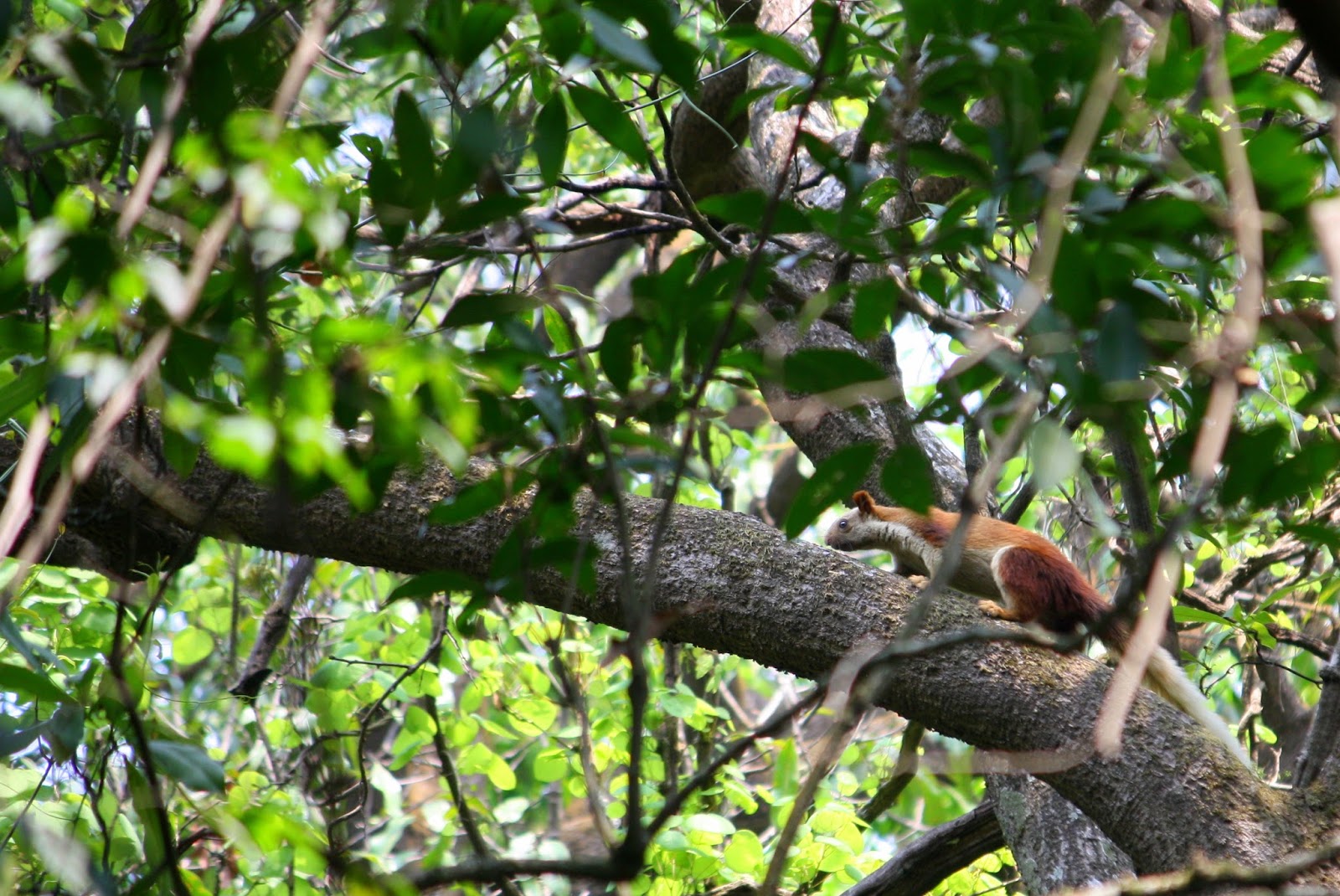


Giant Squirrels at Bhimashankar | Photos: Aniket Sayam
A small climb up from the parking lot and you at the Nagphani point, looking at the breathtaking surrounding mountains of the Sahyadri ranges, this is the highest peak in Bhimashankar. The uphill climb is totally worth the efforts and just cannot be described in an article. You need to experience it. 


The descend from Nagphani Point in Bhimashankar | Photo: Ameya Kolhe

7. MALSHEJ GHAT


Malshej Ghat | Photo: Saruvam
A charming hill station, placed at an altitude of 700 m above the sea level and famous for its numerous lakes, cascading waterfalls, and charming mountains, Malshej Ghat is a favorite tourist destination of hikers, trekkers, adventurers and nature lovers. It is at a distance of 130 km north of Pune. Though Malshej Ghat is beautiful throughout the year, monsoon brings an amazing charm to this place. During monsoons, the beauty and charm of Malshej is visible when it is under heavy fog and dark clouds. Close at hand is the Shivneri Fort, which is famous as the birthplace of Maratha king Shivaji. 

The monsoon is expected to hit Pune and around by mid-June! So take a pick and head out to experience the beauty of the Sahyadris! If you want to join a group and make new friends, join The Western Routes on our Monsoon Excursions, almost every weekend which start by mid-June and go on till September! More updates on our Facebook page or our website - www.thewesternroutes.com

Friday, 13 March 2015

Mango Picking & Tasting in Ratnagiri

How Mango-Mad Are You? 

by Shruti Karkhedkar

Ratnagiri - A land of virgin beaches, cozy and welcoming home-stays, delicious sea food and yes a land of well known Ratnagiri Alphonso (Hapus) Mangoes. Having said that, it is a given that one would click on the ‘Going’ button immediately when a ‘Mango Tasting Tour to Ratnagiri’ is announced. The three day trip from the 16 to 18 May 2014 was organized by The Western Routes, a Pune-based travel company to Ganeshgule, a small village in the Ratnagiri district.


Freshly cut Hapus Mangoes | Photo: Medha Sahasrabudhe

Day 1

We started at 6 am from Pune all packed for a long weekend by the beach. The journey was rather enjoyable and very scenic, particularly after Karad city from where we left the NH-4 and took the smaller village roads. The recent sporadic drizzle had started painting the forests of the Western Ghats with different hues of green which contrasted with the bright blue summer skies and called for a snapshot by every twist and turn round the Ghats. The six hour drive had increased our craving for the much awaited mango meal by a zillion times. 


When we reached the home-stay, were welcomed by Mithil Pitre our host at Ganeshgule. Mithil welcomed us with glasses of cold Panha; a sweet and refreshing drink made with raw mangoes. Mithil runs a home-stay by the beach at Ganeshgule called 'Oceano Pearl’. Our welcome was followed by a wholesome mango meal with unlimited Aamras (fresh mango pulp), plates full of freshly cut mangoes and the regular Maharashtrian thali delicacies – sol kadhi, bhakri, amti and koshimbir.


After lunch and some rest, we visited the Ganeshgule Ganpati temple. The Ganeshgule temple is about 400 years old and is one of the few south-facing temples in India. One of the villagers at the temple narrated a folklore of Lord Ganesha shifting to Ganpatipule from Ganeshgule after the water stopped surging from his navel! 


Once back at the home-stay the next inevitable thing to do was to head to the beach which is literally a hop, skip and a jump away from the home-stay. The Ganeshgule beach is not known to many and hence the feeling of solace adds to the beauty of this white sand beach. We spent rest of the evening taking photographs of the sunset, swimming in the sea and walking by the sea shore. The thoughts of more mangoes awaiting us at the dinner table lured us back to the home-stay.

Ganeshgule Beach | Photo: Raphael Baumann
Ganeshgule Beach | Photo: Jayesh Paranjape
Ganeshgule Beach | Photo: Shruti Karkhedkar

Time-lapse video of the sunset at Ganeshgule beach by Raphael Baumann

Day 2

We started the day with a sabudana khichadi breakfast. Sightseeing was the agenda for the day and Aare-Ware beach our first pit-stop. The Aare and Ware beaches lie next to one another and are separated by a hill. We stopped at a turning on this hill to admire the scenic horizon over the two beaches. Some strategically located shacks served us kokum sarbat, tender coconut water and bhel with loads of kairee (raw mango) pieces.


We then headed to the Ganpatipule temple which is one the most visited and most revered temples in Maharashtra. Needless to say hoards of worshippers awaited their turn to be blessed by the deity. We decided to skip this and take a few clicks of the temple instead. Although constructed recently this red and white structure is aesthetically very appealing unlike many of the modern temple structures.

Ganpatipule Temple | Photo: Raphael Baumann

Ganpatipule Temple | Photo: Raphael Baumann
A trip to Konkan is incomplete without sea-food. On recommendation by a lot of people we had our lunch at Hotel Amantran in Ratnagiri. The lunch was perfect with its crunchy prawn tawa fry, perfectly cooked pomfret fry and a mouth watering surmai. We ended the meal with a rather generous helping of amrakhand (Srikhand with mango pulp). Visit to the Thibaw Palace came next. The palace was used for keeping Thibaw Min, the last king of Burma (now Myanmar) under house arrest.  The palace is now used as museum and a number of artifacts excavated from the Konkan region are on display here.


Surmai Fry Thali
Thibaw Palace | Photo: Raphael Baumann

Our next destination was Purnagad Fort which is said to be the last fort constructed by Shivaji Maharaj, hence the name Purna (Stop) Gad (Fort). At the foot of the Purnagad fort is a rocky sea side and there wasn’t a better way of calling it a day than by sitting on the rocks and getting wet by the splashing sea waves.

Purnagad Fort | Photo: Vidyuth Singh
Purnagad Beach | Photo: Raphael Baumann

Day 3

The day started with a session of making sand castles by the beach followed by a breakfast of ambolis (pancakes made from rice flour) with coconut chutney. We followed this with a fun session of mango picking at a nearby orchard in Ganeshgule. We got to select ready-to-pick mangoes and then use an ingenious and traditional technique to pick the mangoes.


Mango Picking at Ganeshgule | Photo: Raphael Baumann

Finally with a heavy heart we said bye to our hosts. But we made sure that we bought loads of ‘food’ souvenirs. The perfect spot to do this was at the Deshmukh household in Pawas village who have a small unit where mango and jackfruit pulp is canned. They also sell high quality Alphonso mangoes which are exported across the globe. The advantage of buying Alphonso mangoes directly at the source is that they are almost three times cheaper than in Pune or Mumbai.

We bought mangoes enough to last us this season and with alphonso sweet memories headed back home! 

More details about the Mango Picking & Tasting Tour for 2015 is on their Facebook page  or on the event page here

This travel story first appeared in the Mumbai edition of Mid-Day in May 2014. Read the full story here

Wednesday, 4 March 2015

The Heart-throb of Umred-Karhandla


Meet Jai

This magnificent Tiger is the heart throb of the woods of Umred Karhandla Wildlife Sanctuary near Tadoba Tiger Reserve. About 2 years ago Jai and his friend Veeru roamed in the jungles of Nagzira Tiger Reserve. And then one day they were no where to be seen. The forest guards thought they had been killed by poachers when the duo didn't return for months. Fortunately, Jai was spotted again in 2013 in Umred Karhandla. However, no one knows the where abouts of Veeru.


Join The Western Routes as we head to the jungles of Tadoba and Umred Karhandla this summer to sight this charismatic species! More details on our Facebook page!

All Photos of Jai taken by Aniket Sayam at Umred-Karhandla Wildlife Sanctuary

Monday, 16 February 2015

AN OCTOPUSSY SURPRISE!

AN OCTOPUSSY SURPRISE! 


Look what we found as we waited to be ferried across the Savitri River! While looking for mud-skippers at the Bankot creek this octopus made a surprise appearance! We went crazy photographing this beautiful creature! 

Commonly known as 'Monsters of the Sea' these molluscs are abundantly found in tropical warm waters. These active predators are considered among the most intelligent invertebrates. They feed on crabs, shrimps and lobsters and can even attack sharks. They drop on their prey and with the help of the suckers on their arms pull the organism into their mouth. Their saliva is venomous and helps to subdue the prey. The Octopus is known for its defence mechanism. When threatened it releases an inky fluid from the ink sac which darkens the water and helps it escape. At times the octopus can lose its arm to escape the predator and re-grow it later without any permanent damage!

Photo: Vikram Vyawahare

Photo: Vikram Vyawahare

Photo: Aniket Sayam
Our next trip to experience the Turtle Festival at Velas is coming up on 7-8 March 2015. More details on our Facebook page! 


Friday, 6 February 2015

Fish Auction @ Harnai

FISH AUCTION AT HARNAI BEACH

A photo-feature by Vinit Godbole

Harnai or more commonly Harne is a coastal village in the Ratnagiri district of Konkan. It is around 15 km from Dapoli and neighbors beautiful beaches of Murud, Karde and Anjarle. Being one of the natural harbors, Harnai is an ideal wharf for fish trading. The fish auction at Harnai village is one of the most sought after events in the area and is a daily custom held in the morning from 7 am to 9 am and in the evening from 4 pm to 7 pm. The market is known to sell different varieties of fish like Pomfret, Surmai, Tiger Prawns, Squids, Lobsters, Sting rays, Mackerel, and many more. The auction lures many travelers and photographers. Tourists can indulge in the fish fest of betting and auctioning. Apart from fish, Harnai is also known for the magnificent Harnai Fort located on the northern front of the village.


Find this destination in the Uncharted Konkan Lands itineraries with The Western Routes. More details on www.thewesternroutes.com/tours