Call of the Ocean
By Manasi Agavekar
With inputs from the travelogue written by Prajakta Ponkshe in Marathi
Travelling has always been one of my favorite hobbies but this trip was specially planned for my daughter Aarushi, who has recently finished IX standard exams, and within a week she was going to be engulfed by the challenges of ‘the dreaded X standard’. We both being nature enthusiasts, had zeroed in on a trip to Velas (a quiet village in Ratnagiri) that offered us a unique and ‘Animal Planet’ like experience of turtle hatching, and the release of baby turtles into the sea.
This is an amazing conservation project where the community of protection of this life form is managed by locals. The Olive Ridley turtles, a marine endangered species of the reptiles, lay eggs along the Maharashtra coastline at multiple places and incidentally, Velas is the place where most of the eggs are concentrated. For years, their eggs would be either stolen, eaten or sold. Besides fishing, hunting, pollution has been a major cause for their extinction. The Sahyadri Nisarg Mitra, an NGO funded from CSR initiatives, not only runs this conservation project but also offers an alternative source of livelihood to the locals through home stays for the tourists. Staying among the locals and living their lives was a new experience.

We set off on our journey on a mini bus with a group called ‘The Western Routes’ with about 13 people, on Friday at about 12:45 in the night. This was designed so that we have a maximum chance at sighting the turtles being released in to the sea. I invariably woke up multiple times throughout the night, because of the awkward position in spite of the seats having a push-back facility, whereas Aarushi had managed some sleep. We reached Velas at 6 am. The air was fresh and comfortably cold. It was still dark, and a small charming house was assigned to us as a home stay. It had three rooms with a neat bath and toilet facility, an elevated porch, and a backyard that was converted into a shack, which acted as our dining area.
Before the starting of any trip, I had the usual inhibitions about the people that would make our group, the stay, the hygiene, the food, the overall experience, and here the most important thing whether we would get a chance at sighting the turtles. Well it loomed for a while, but as the morning tea arrived, we all stared interacting and a general sense of comfort began to set in. We immediately started for the beach where the hatchery is located. It was a tricky narrow path down the beach with the marshes of mangroves on one side and a few fields on the other. The hatchery is in the form of an enclosure made of a net, on the beach where in the turtle nests were neatly arranged according to the date of hatching. It was actually towards the end of their breeding season but at least 15 nests were seen, that made all of us hopeful. The authorized people came to check on the nest at 7 am. But luck wasn’t in our fate that day as there was no activity of any hatchlings surfacing that time or even that day. We were completely disappointed, and didn’t know what to make of the situation. We had actually come all the way for that.
 |
| An Olive Ridley Turtle hatchling mmaking its way to the sea. Photo: Anshul Khandelwal |
So we had an official introductory session, where we came to know about the names, the places and the professions of our fellow members. It seemed to me like very diverse set people. There were two foreigners, Sebastian, an IT professional from Argentina and Nazneen, a PhD student from Iran. And we all thought there was no chance of us being friends with them as they seemed quiet reclusive and kept to themselves. Later we realized that it was because Nazneen herself could not speak fluent English, nor was Sebastian very comfortable with the language. Few people of the group acted as translators for them so they could join in on the fun. Other people of the group were from Pune. I became close friends with a lady who was traveling with her 12-year-old son. Her name was Prajakta, an artist by profession. She had that knack of seeing art even in the smallest details and was an excellent photographer. Kishor, worked in the Oberoi chain of hotels as a regional sales manager. He being from hotel industry, we had some common subjects, and we got along pretty well. Most of hobbies and interests matched. He was an art enthusiast and a talented dramatist. Another woman named Disha worked in a gaming firm as a data analyst was in the group. She is a sweet and lovable was friends with everybody. The head of the group, Jayesh, was an enthusiastic and well-travelled man of many experiences. He had brought along his nephew, Reeshabh, who is an exceptionally talented classical singer. There were other people too, like the designer Gurbans, who is Punjabi, an excellent photographer, Shailesh and the fun-loving Kulkarni Aunty.
 |
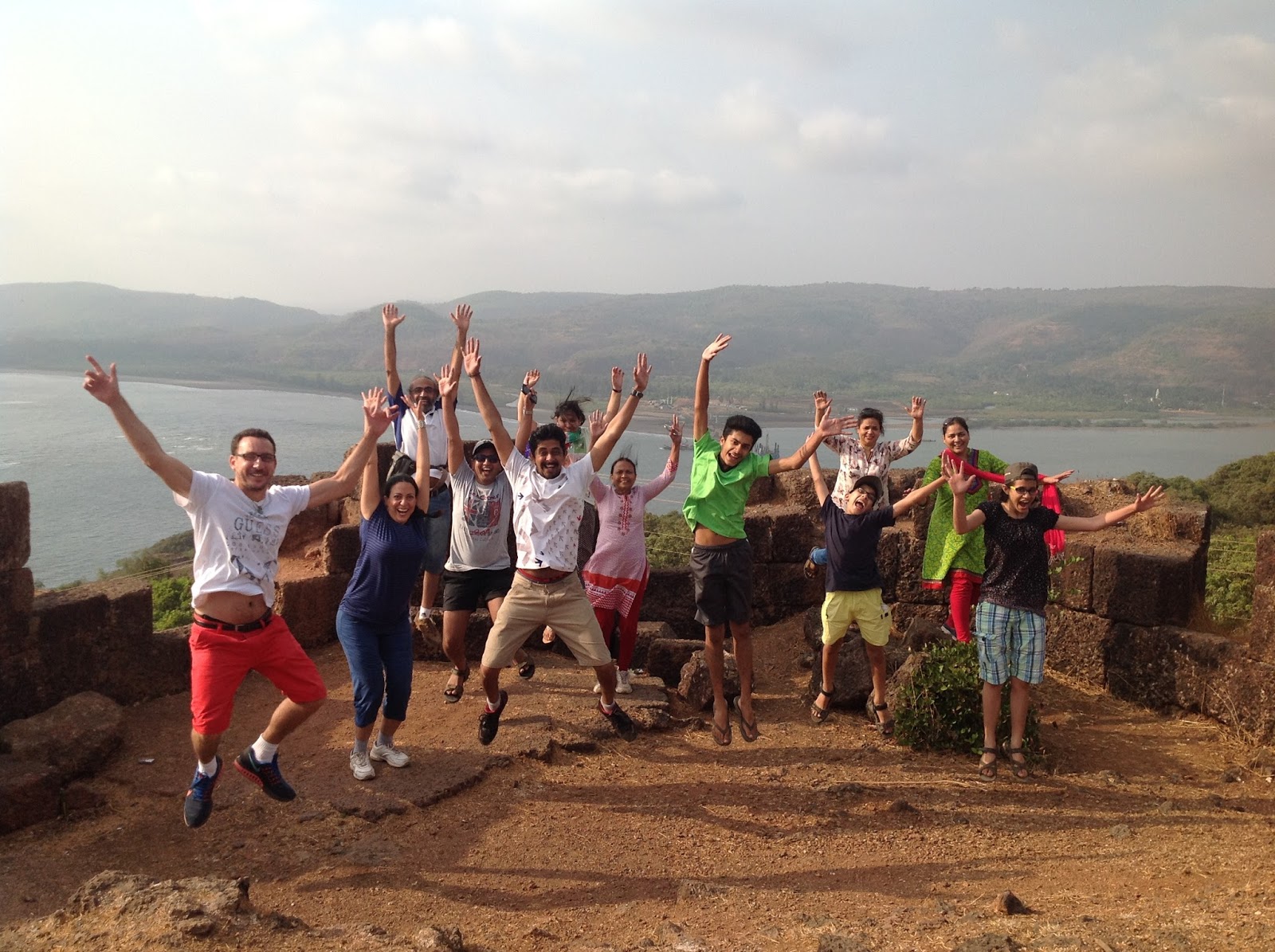
| Our group atop Bankot Fort |
The group became well-versed with each other only after lunch on the first day, when we played a game of relating the funniest moment of our life so far. This was the best ice breaking session I had ever experienced, there were more than 13 such incidences told, and we laughed our guts out for more than an hour. The comfort level with everyone was regulated. There was no awkwardness left anymore and we fit in with each other like we were age-old friends. One of the highlights of the trip was the constant humor. Not one dull moment passed in those two days. Even the people who couldn’t understand Marathi joined in when we were laughing because the joke was simultaneously translated by one member.
In the afternoon, we went for a ‘Heritage and Culture Walk’ in the village. For the two hours that we roamed in the mild sun, we opened up about the memories we had in the part of Konkan, which is inevitable for any Maharashtrian. The peace, the quiet, the serenity. We felt disconnected to our busy lives in Pune and we connected to our fundamental roots. The beautiful orchards of supari, coconut and mango trees bursting with birdsong, and our voices were the only sounds we heard.
After that, we visited the fort Himmatgadh. It wasn’t a fort of great prowess, but it was an important one for Shivaji Maharaj and the Peshwas. Strategically placed at the meeting of the river Savitri to the sea and the sea coast, it was more of a watch-post rather than a full-fledged livable fort. It is still mostly intact. The sight was breath-taking and the climate was fantastic. The wafting sea-breeze, stunning views and the group photo sessions made the visit amazing. In the evening, after the third dose of tea, we set out for the beach again with hopes of seeing baby turtles. But luck was refusing to co-operate with us. Nevertheless, we had the share of the beach and the relentless sea. The glorious sunset compensated for the absence of the turtles.
 |
| Simple, home-cooked food at Velas |
In the afternoon, we went for a ‘Heritage and Culture Walk’ in the village. For the two hours that we roamed in the mild sun, we opened up about the memories we had in the part of Konkan, which is inevitable for any Maharashtrian. The peace, the quiet, the serenity. We felt disconnected to our busy lives in Pune and we connected to our fundamental roots. The beautiful orchards of supari, coconut and mango trees bursting with birdsong, and our voices were the only sounds we heard.
 |
| Walking through the 'Supari' orchards was fun! |
After that, we visited the fort Himmatgadh. It wasn’t a fort of great prowess, but it was an important one for Shivaji Maharaj and the Peshwas. Strategically placed at the meeting of the river Savitri to the sea and the sea coast, it was more of a watch-post rather than a full-fledged livable fort. It is still mostly intact. The sight was breath-taking and the climate was fantastic. The wafting sea-breeze, stunning views and the group photo sessions made the visit amazing. In the evening, after the third dose of tea, we set out for the beach again with hopes of seeing baby turtles. But luck was refusing to co-operate with us. Nevertheless, we had the share of the beach and the relentless sea. The glorious sunset compensated for the absence of the turtles.

After returning ‘home’, the talented people among us showcased their skills that evening before dinner. Reeshabh sung some classical favorites which enchanted us. Kishor performed a part of Maharashtra’s cult favorite play Varhad Nighalay Londonla with outstanding skill and verve. After dinner, we went for a stroll on the beach for stargazing. Few people among us knew the sky well and we spotted huge constellations which are never visible in the city. While we were returning, there was no one on the road but us. We were technically very alone but the group of the thirteen of us didn’t let anybody feel that way.
After a good night’s sleep, we went on the beach once again early in the morning. There were depressions in the sand at the hatchery, which meant that the eggs were hatched but the hatchlings hadn’t made their way up yet. It was extremely frustrating but later, we made up for the lost turtles by seeing the pet turtle one of the villagers had. It was grown-up but it was a turtle. We then went for a ‘raft-ride’ in the nearby creek, which was awesome fun, even in the beating sun. After lunch, we bid adieu to this gorgeous little village and made our way to Shrivardhan. The bus ride was spent spotting trees and birds. In Shrivardhan, we loaded our bus in a ferry and made our way across the little canal. The ferry ride was short, just 7-8 minutes, but it was pleasant.
In Shrivardhan we set off to place where vulture nest were in abundance, it was just a 10 mins walk from the hotel that we were to have lunch. This also was supposedly a conservation site because vultures aren’t considered holy by our community and so killed. But here also efforts had been taken towards conservation of these birds as they are an important part of our food chain. Locals had to educated and encouraged. Here we spotted more than 3 nests perched high up in coconut trees with numerous vultures looming around. Birding has always enchanted me, and this was indeed a special moment. Besides vultures this part of konkan is a rich with many more such birds, we were lucky to spot eagles and kingfishers.
After a hearty lunch of modak and ‘sol kadhi’, we then braced ourselves for a long ride back home. The ride didn’t seem so long because of the songs Jayesh was playing and the jokes we made constantly at every little thing. We then had an ‘ice-cream break’ after 2 or so hours of travel. The road seemed endless and we wanted it that way, but our coffee stop was the last meal we were going to have together. Prajakta teared up at the thought and everyone was gulping the reality: this is the end of the fun which seemed endless. The next hour or so, the verve of the group was dimmed.

We made a Whatsapp group, shared our photos. We exchanged numbers and promised to stay in touch. One by one, we dropped off everyone near their homes. Reeshabh was the first one to get off and I and my daughter were the last ones. It was odd to sit by ourselves in the bus, the two of us, with only the sounds of honks and brakes. We got off near our home and it just felt so weird being in civilization after so long.
Maybe, it is better being disconnected with the busy world, after all if it means connect with nature!


