Showing posts with label Velas. Show all posts

Thursday, 21 April 2016

Call of the Ocean


By Manasi Agavekar

With inputs from the travelogue written by Prajakta Ponkshe in Marathi

Travelling has always been one of my favorite hobbies but this trip was specially planned for my daughter Aarushi, who has recently finished IX standard exams, and within a week she was going to be engulfed by the challenges of ‘the dreaded X standard’. We both being nature enthusiasts, had zeroed in on a trip to Velas (a quiet village in Ratnagiri) that offered us a unique and ‘Animal Planet’ like experience of turtle hatching, and the release of baby turtles into the sea.

This is an amazing conservation project where the community of protection of this life form is managed by locals. The Olive Ridley turtles, a marine endangered species of the reptiles, lay eggs along the Maharashtra coastline at multiple places and incidentally, Velas is the place where most of the eggs are concentrated. For years, their eggs would be either stolen, eaten or sold. Besides fishing, hunting, pollution has been a major cause for their extinction. The Sahyadri Nisarg Mitra, an NGO funded from CSR initiatives, not only runs this conservation project but also offers an alternative source of livelihood to the locals through home stays for the tourists. Staying among the locals and living their lives was a new experience.


We set off on our journey on a mini bus with a group called ‘The Western Routes’ with about 13 people, on Friday at about 12:45 in the night. This was designed so that we have a maximum chance at sighting the turtles being released in to the sea. I invariably woke up multiple times throughout the night, because of the awkward position in spite of the seats having a push-back facility, whereas Aarushi had managed some sleep. We reached Velas at 6 am. The air was fresh and comfortably cold. It was still dark, and a small charming house was assigned to us as a home stay. It had three rooms with a neat bath and toilet facility, an elevated porch, and a backyard that was converted into a shack, which acted as our dining area. 

Before the starting of any trip, I had the usual inhibitions about the people that would make our group, the stay, the hygiene, the food, the overall experience, and here the most important thing whether we would get a chance at sighting the turtles. Well it loomed for a while, but as the morning tea arrived, we all stared interacting and a general sense of comfort began to set in. We immediately started for the beach where the hatchery is located. It was a tricky narrow path down the beach with the marshes of mangroves on one side and a few fields on the other.  The hatchery is in the form of an enclosure made of a net, on the beach where in the turtle nests were neatly arranged according to the date of hatching. It was actually towards the end of their breeding season but at least 15 nests were seen, that made all of us hopeful. The authorized people came to check on the nest at 7 am. But luck wasn’t in our fate that day as there was no activity of any hatchlings surfacing that time or even that day. We were completely disappointed, and didn’t know what to make of the situation. We had actually come all the way for that.

An Olive Ridley Turtle hatchling mmaking its way to the sea. Photo: Anshul Khandelwal

So we had an official introductory session, where we came to know about the names, the places and the professions of our fellow members. It seemed to me like very diverse set people. There were two foreigners, Sebastian, an IT professional from Argentina and Nazneen, a PhD student from Iran. And we all thought there was no chance of us being friends with them as they seemed quiet reclusive and kept to themselves. Later we realized that it was because Nazneen herself could not speak fluent English, nor was Sebastian very comfortable with the language. Few people of the group acted as translators for them so they could join in on the fun. Other people of the group were from Pune. I became close friends with a lady who was traveling with her 12-year-old son. Her name was Prajakta, an artist by profession. She had that knack of seeing art even in the smallest details and was an excellent photographer. Kishor, worked in the Oberoi chain of hotels as a regional sales manager.  He being from hotel industry, we had some common subjects, and we got along pretty well. Most of hobbies and interests matched. He was an art enthusiast and a talented dramatist. Another woman named Disha worked in a gaming firm as a data analyst was in the group.  She is a sweet and lovable was friends with everybody. The head of the group, Jayesh, was an enthusiastic and well-travelled man of many experiences. He had brought along his nephew, Reeshabh, who is an exceptionally talented classical singer. There were other people too, like the designer Gurbans, who is Punjabi, an excellent photographer, Shailesh and the fun-loving Kulkarni Aunty.

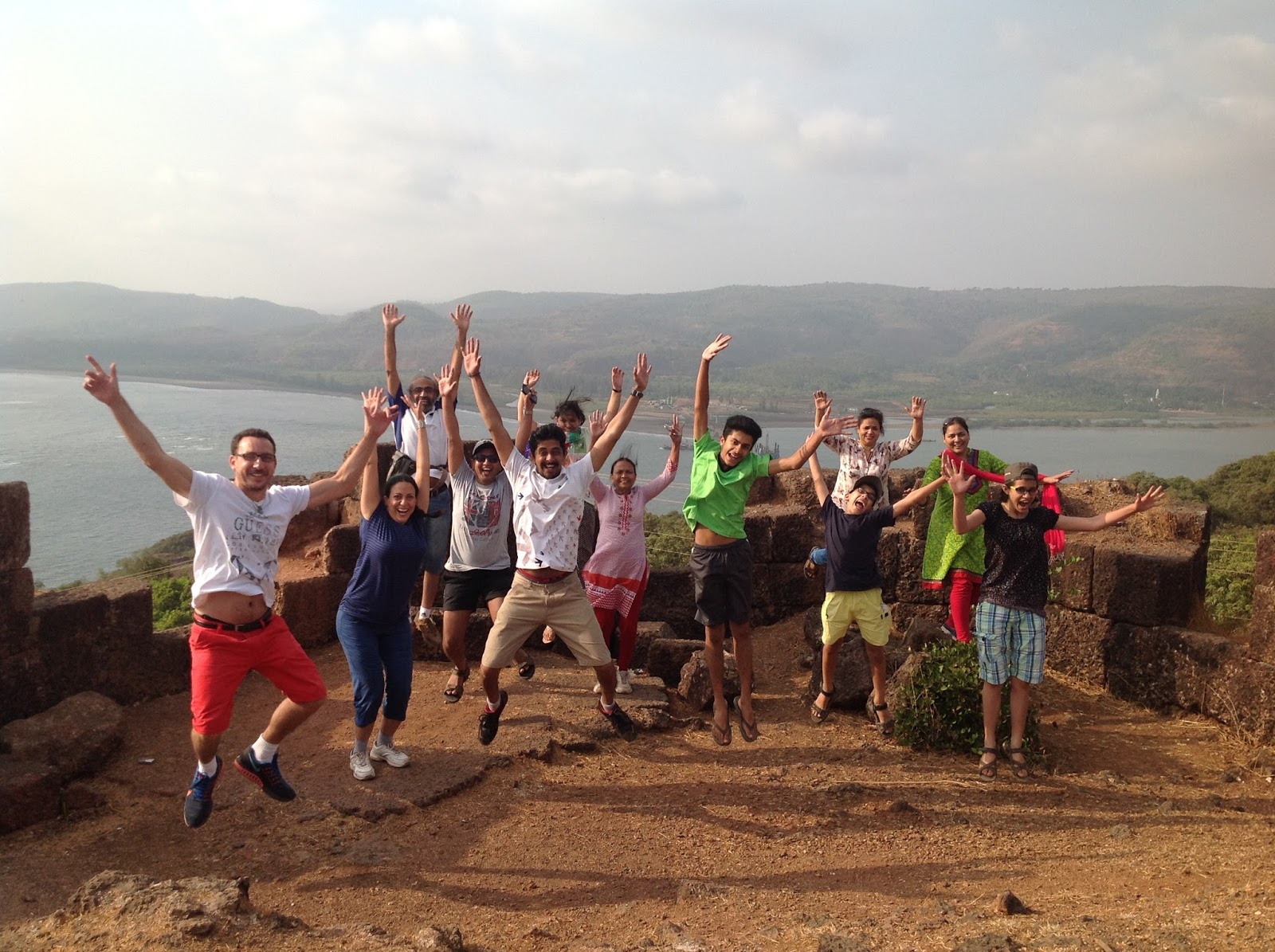
Our group atop Bankot Fort

The group became well-versed with each other only after lunch on the first day, when we played a game of relating the funniest moment of our life so far. This was the best ice breaking session I had ever experienced, there were more than 13 such incidences told, and we laughed our guts out for more than an hour. The comfort level with everyone was regulated. There was no awkwardness left anymore and we fit in with each other like we were age-old friends. One of the highlights of the trip was the constant humor. Not one dull moment passed in those two days. Even the people who couldn’t understand Marathi joined in when we were laughing because the joke was simultaneously translated by one member. 


Simple, home-cooked food at Velas

In the afternoon, we went for a ‘Heritage and Culture Walk’ in the village. For the two hours that we roamed in the mild sun, we opened up about the memories we had in the part of Konkan, which is inevitable for any Maharashtrian. The peace, the quiet, the serenity. We felt disconnected to our busy lives in Pune and we connected to our fundamental roots. The beautiful orchards of supari, coconut and mango trees bursting with birdsong, and our voices were the only sounds we heard.


Walking through the 'Supari' orchards was fun!

After that, we visited the fort Himmatgadh. It wasn’t a fort of great prowess, but it was an important one for Shivaji Maharaj and the Peshwas. Strategically placed at the meeting of the river Savitri to the sea and the sea coast, it was more of a watch-post rather than a full-fledged livable fort. It is still mostly intact. The sight was breath-taking and the climate was fantastic. The wafting sea-breeze, stunning views and the group photo sessions made the visit amazing. In the evening, after the third dose of tea, we set out for the beach again with hopes of seeing baby turtles. But luck was refusing to co-operate with us. Nevertheless, we had the share of the beach and the relentless sea. The glorious sunset compensated for the absence of the turtles. 


After returning ‘home’, the talented people among us showcased their skills that evening before dinner. Reeshabh sung some classical favorites which enchanted us. Kishor performed a part of Maharashtra’s cult favorite play Varhad Nighalay Londonla with outstanding skill and verve. After dinner, we went for a stroll on the beach for stargazing. Few people among us knew the sky well and we spotted huge constellations which are never visible in the city. While we were returning, there was no one on the road but us. We were technically very alone but the group of the thirteen of us didn’t let anybody feel that way.

After a good night’s sleep, we went on the beach once again early in the morning. There were depressions in the sand at the hatchery, which meant that the eggs were hatched but the hatchlings hadn’t made their way up yet. It was extremely frustrating but later, we made up for the lost turtles by seeing the pet turtle one of the villagers had. It was grown-up but it was a turtle. We then went for a ‘raft-ride’ in the nearby creek, which was awesome fun, even in the beating sun. After lunch, we bid adieu to this gorgeous little village and made our way to Shrivardhan. The bus ride was spent spotting trees and birds. In Shrivardhan, we loaded our bus in a ferry and made our way across the little canal. The ferry ride was short, just 7-8 minutes, but it was pleasant. 

In Shrivardhan we set off to place where vulture nest were in abundance, it was just a 10 mins walk from the hotel that we were to have lunch. This also was supposedly a conservation site because vultures aren’t considered holy by our community and so killed. But here also efforts had been taken towards conservation of these birds as they are an important part of our food chain. Locals had to educated and encouraged. Here we spotted more than 3 nests perched high up in coconut trees with numerous vultures looming around. Birding has always enchanted me, and this was indeed a special moment. Besides vultures this part of konkan is a rich with many more such birds, we were lucky to spot eagles and kingfishers.

After a hearty lunch of modak and ‘sol kadhi’, we then braced ourselves for a long ride back home. The ride didn’t seem so long because of the songs Jayesh was playing and the jokes we made constantly at every little thing. We then had an ‘ice-cream break’ after 2 or so hours of travel. The road seemed endless and we wanted it that way, but our coffee stop was the last meal we were going to have together. Prajakta teared up at the thought and everyone was gulping the reality: this is the end of the fun which seemed endless. The next hour or so, the verve of the group was dimmed.  


We made a Whatsapp group, shared our photos. We exchanged numbers and promised to stay in touch. One by one, we dropped off everyone near their homes. Reeshabh was the first one to get off and I and my daughter were the last ones. It was odd to sit by ourselves in the bus, the two of us, with only the sounds of honks and brakes. We got off near our home and it just felt so weird being in civilization after so long. 

Maybe, it is better being disconnected with the busy world, after all if it means connect with nature!

Monday, 16 February 2015

AN OCTOPUSSY SURPRISE!

AN OCTOPUSSY SURPRISE! 


Look what we found as we waited to be ferried across the Savitri River! While looking for mud-skippers at the Bankot creek this octopus made a surprise appearance! We went crazy photographing this beautiful creature! 

Commonly known as 'Monsters of the Sea' these molluscs are abundantly found in tropical warm waters. These active predators are considered among the most intelligent invertebrates. They feed on crabs, shrimps and lobsters and can even attack sharks. They drop on their prey and with the help of the suckers on their arms pull the organism into their mouth. Their saliva is venomous and helps to subdue the prey. The Octopus is known for its defence mechanism. When threatened it releases an inky fluid from the ink sac which darkens the water and helps it escape. At times the octopus can lose its arm to escape the predator and re-grow it later without any permanent damage!

Photo: Vikram Vyawahare

Photo: Vikram Vyawahare

Photo: Aniket Sayam
Our next trip to experience the Turtle Festival at Velas is coming up on 7-8 March 2015. More details on our Facebook page! 


Tuesday, 27 January 2015

Velas – The Turtle Village!

Velas – Village of Turtles & More! 

By Jayesh Paranjape


There are some wildlife spectacles or events around the world that are a must-see or must-experience for a wildlife enthusiast like me. Be it the Great Migration at Serengeti in Africa, Brown Bears feasting in Alaska, King Penguin rookery at St. Andrews Bay or the Olive Ridley Turtles nesting and hatching in Orissa. As a kid, I had heard about the Olive Ridley Turtles who swim for thousands of miles and make their way to the Gahirmata Beach in Orissa to lay eggs and dreamt of visiting this place one day. I always wondered how it would be to witness an Animal Planet-like moment when tiny turtle hatchlings, make that journey from the hatched egg to the sea. 

Photo: Anshul Khandelwal
Of course I had never heard or imagined that the Olive Ridleys also had sporadic nesting sites across the western coast too. In 2008, when I was working with Sanctuary Asia (a leading wildlife magazine) I received an invitation to attend the first ever ‘Turtle Festival’ at Velas village in Maharashtra. It was almost like a dream come true. Unfortunately due to busy work schedules, I never got a chance to visit the festival. Since then, every year during March & April, my Facebook newsfeed was occupied by photographs of turtle hatchlings being released and making their way to the sea. In 2012 after a short stint in the UK where I studied responsible tourism management (and often spoken about the eco-tourism model of the turtle festival in Velas), I returned to India and got a chance to visit Velas for the turtle festival! And I got so hooked on to the whole concept that I have been visiting Velas every year since then.

Plus Valley at Tamhini Ghat
We started our journey from Pune early on a Saturday morning. We decided to take the Tamhini Ghat route from Mulshi which is the shortest route to reach Velas by road (around 180 km). The road condition was a bit dodgy, but the stunning views of the valley made up for the bad roads. After a 4 hour bumpy ride through the Tamhini Ghat-Mangaon-Mandangad-Bankot route, we finally arrived in Velas for lunch. We were welcomed by Sunil Darge and his family who were to be our hosts for the next 2 days. After a quick round of chai, we set out to explore the village. 


Velas is the quintessential Konkani village with low thatched sloping roofs, spotless and clean dung-smeared courtyards, narrow roads lined with jackfruit trees and backyards full of coconut, betel nut, kokam and mango trees. Velas is the birth place of Nana Phadnis, one of the most influential ministers of the Maratha Empire during the Peshwe administration. There is a small ‘smarak’ or shrine dedicated to him at his birth-house. Apart from this, there are 2 temples one can visit while in Velas - Shri Bhairi-Rameshwar temple built by the Peshwas and the Mahalaxmi temple which also plays host to a slide show and a film screening in the evening during the turtle festival. 


After a sumptuous home-cooked lunch, which was served on banana leaves, we headed to the Bankot Fort which is around 5 km from Velas. The fort which is strategically located overlooks the sea as well as the Bankot creek of the Savitri River. The view from the fort is stunning, particularly if you visit it early in the morning or late afternoon. A consistent historical timeline or the origin of the Bankot fort is not known. The fort was known to be under the control of Adilshahi and later in 1548, the Portuguese took control over it. The Marathas, under the leadership of Kanhoji Angre took control over Bankot and rechristened it as Himmatgad. When the British took over the fort, the name was changed to Fort Victoria. With its stunning views of the sea and the river, the Bankot fort is a must-visit while one is at Velas. 


After exploring the village and the fort, we headed to Velas beach to see the release of the turtles. The release of turtles happens twice a day – at 6 am and 6 pm. The protection of eggs and marine turtle conservation in Maharashtra was started by a Chiplun based NGO called Sahyadri Nisarga Mitra (SNM) in 2002. The conservation story goes something like this. In February 2001, SNM found evidence of around 35 turtle nests at Velas. Unfortunately they also found that poaching of turtle eggs was quite high as egg poaching is a traditional practice for some communities along the coast of Maharashtra. Add to this, predation of eggs by stray dogs, jackals and crows. In 2002, SNM decided to undertake protection and conservation of turtles at Velas. In first year they protected around 50 nests of the Olive Ridley Turtles and released more than 2700 hatchlings in the sea. Every year, volunteers from SNM patrol the beaches for evidence of nests in the months of December & January. They manually shift the eggs to a protected & barricaded patch on Velas beach and recreate the nest conditions here. Nature takes its course and in around 50-55 days, the eggs hatch and the turtles are ready to make their way to the sea. In 2008, SNM joined hands with the Gram Panchayat at Velas, the residents of Velas village and the forest department office to organize the first ever Turtle Festival. The local community agreed to open their homes and provide accommodation and home-cooked meals to the tourists who come to the festival. They also agreed to donate a part of their earnings and their valuable time and energy for the cause of turtle conservation. The turtle festival at Velas is one of the few examples of community-based eco-tourism in our country. 


In the evening we were lucky to witness the release of more than 40 turtle hatchlings. It is an amazing experience to witness the first walk of these turtles. The Olive Ridley Turtles are an endangered species named for their olive green colour. These turtles migrate thousands of miles once every year for arribada i.e. to lay eggs on the same shore where they had hatched around 15 years back! When the eggs hatch, the hatchlings make their way to the sea and in the process the large quantities of magnetite in their brains helps them to read the Earth’s magnetic field so that they can navigate back to the same shore to nest. It is estimated that approximately one turtle survives to reach adulthood for every 1000 that enter the sea. What a fascinating species! 


Photos: Anshul Khandelwal
Photo: Anagha Bodas
After experiencing the release we came back to our homestay and enjoyed a piping hot meal of jackfruit vegetable with lots of coconut, rice bhakri and of course the Konkani prawn curry made by Sunil’s wife. The next day at 6 am we were back on the beach and saw another 2 hatchlings make their way to the sea. As these two hatchlings made their way to the sea, they were followed by cameras. After lunch we started our journey back en-route Harihareshwar. The ferry boat ride from Bankot to Bagmandla is worth a visit. On the short ferry ride you can sit atop the viewing gallery and beat the heat with a kokum sarbat (juice) which is sold on the boat along with hot yummy wada pav. 


When we reached Pune, I slept peacefully and dreamt of those 2 hatchlings. I dreamt that they had survived against all odds, reached adulthood and had come back to Velas for nesting. After my first visit in 2012, I have gone back to Velas every year for the Turtle Festival and convinced more and more people to join me on these trips! At Velas it is not just about the turtle festival but so much more – the rural life, the food, the history and most importantly the people.

This article was first published for Citadel Magazine, Pune Edition and republished in 'Routes & Trails' July 2014 issue.

Wednesday, 17 December 2014

Eight Wonders of Coastal Ratnagiri!


8 WONDERS OF COASTAL RATNAGIRI

You drive up mountains and glide down green valleys and all along yearn to finally reach the ocean front. Just as you wonder if the journey is on forever, suddenly the ocean meets your eyes. You remain transfixed! Situated on the gorgeous western coast of India, the Ratnagiri district is home to some of the most stunning landscapes. Thanks to the presence of the majestic Sahyadris range on one side and and the beautiful Arabian Sea on the other. The sandy beaches, rocky outcrops and small but vital estuaries along the Ratnagiri coast are ideal spots to reconnect with nature. Add to this the friendly and ever helpful people and the yummy Konkani cuisine. A combination that you don't want to miss! Here are The Western Routes' EIGHT most favorite destinations around coastal Ratnagiri!


Velas

A newly hatched Olive Ridley Turtle making its way to the sea. Photo: Anshul Khandelwal

Ever wondered how it would be to witness an Animal Planet like moment when tiny turtle hatchlings, make that journey from the hatched egg to the sea? Between February to April, nature enthusiasts can actually experience this rare event on the Velas beach in Ratnagiri district. A local NGO from Chiplun, Sahyadri Nisarga Mitra, started this project in 2002 and in the first year they protected 50 nests of Olive Ridley (Lepidochelys olivacea) and released more than 2700 hatchlings in the sea. Now, Sahyadri Nisarga Mitra, has joined hands with the Gram Panchayat at Velas and the local Forest department office to organise a unique Turtle Festival each year. The villagers are actively involved in the conservation of these turtles. They offer their homes as home-stays to the tourists who come to Velas during the festival. Once in Velas, you can also visit the Himmatgad fort or take a ferry boat from Bankot to the beautiful Harihareshwar Beach.

Check out the Olive Ridley hatchlings making their way to the sea!


Anjarle

The Kadyawarcha Ganpati Temple in Anjarle. Photo: Kedar Champhekar

Anjarle is one of the most secluded beaches in the Konkan belt. The 2 km stretch is full of crystal like scintillating white sand and sparking clean water, surrounded by an array of palm trees. Adjoining the beach is the traditional pastoral Anjarle village. Anjarle is also known for the legendary Ganpati Temple. The Kadyavarcha Ganpati (temple on a cliff) is one of the well-known prehistoric temples of India and dates back to 1500 A.D. It is known for its architecture. The temple has a very beautiful primordial décor with stone staircases leading to the temple’s Kalas (mast) on the top. There is also a fishpond in front of the temple alongside a shrine of Lord Shiva. The Ganesh Idol here is rare and locally called as “Ujwya Sondecha Ganpati” (trunk turned to the right side), a very rare sight for the devotees. This Ganpati is also known for wish fulfilling powers, traditionally called as “navsala pavnara Ganpati”. Hence in the customary dialect, it is referred as ‘Jagrut Daiwat’ or a very lively God.


Murud, Karde & Harnai


One of the beaches between Murud and Harnai. Photo: Vinit Godbole


Have you ever been to a fish fight (fish, fishing and trading)? You can experience one at Harnai village, around 12 km from Dapoli. Being one of the natural harbors, it is an ideal wharf for fish trading. The fish auction at Harnai village is one of the most sought after events in the area and is a daily custom held between 8 am to 10 am in the morning and 4 pm and 7 pm in the evening. The market is known to sell different varieties of fish like Pomfret, Surmai, Tiger Prawns, Squids, Lobsters, Mackerel, and many more. The fish quality is high and has lured many travelers and photographers. Tourist can also indulge in the fish fest of betting and auctioning. Apart from the auction, Harnai is also known for the magnificent Harnai Fort located on the northern front of the village.

Some glimpses from the Fish Auction at Harnai Beach. Photos: Vinit Godbole


The Murud & Karde beaches are known for its marvelous, mesmerizing, and friendly  Dolphins. The Murud-Karde beach stretch is situated around 12 km from Dapoli. The coastal hamlet of Murud serves a variety of yummy fishes cooked in local masalas (seasoning) that are known world-wide. The area is also a culturally rich coastal community acknowledged for its Diwali and Holi celebrations. Head to these twin beaches to indulge into some touristy things like water sports and boat rides or simply for the breath-taking sunset or being in the company of the affable Dolphins.

Velneshwar & Hedvi


Photo: Raphael Baumann


Around 20 km south of the famous Guhagar Beach and to the north of the Shastri River lies the idyllic village of Velneshwar. The quiet, coconut-fringed beach offers tourists the ideal opportunity for swimming or just relaxing without any tourist disturbance. There is an old Shiva temple in the environs which is often frequented by pilgrims particularly during the Maha Shivratri festival. A few kilometers away from Velneshwar is Hedvi, which is known for its unique Dashabhuja Ganapati. Standing 3 feet tall and carved in white stone, the ideol, is beleived to be from the Kashmir region and has ten hands, hence the name ‘Dashabhuja’. While in Hedvi, do not miss experiencing the water rising to almost 30-40 feet at one point along the beach. This is called as Brahman Ghal. It is a rare natural phenomenon where the sea water has created a gorge in the black rock patch, which is around 20 feet deep and 2 feet wide. When the sea water gushes in the vertical column, it rises through the gorgre for almost 30-40 feet!

Ganpatipule

Ganpatipule Temple. Photo: Raphael Baumann


‘Ganpatipule’ – the name itself suggest the place of Lord Ganesha. Ganpatipule is one of the ‘Astha Ganpatis’ (Eight Ganesha pilgrim centers) of India. The idol is believed to be nearly 400 years old is ‘swayambhu’ or self-created. The divine abode is blessed with sparkling beaches, and jagged coconut palm and mangroves along the coastline. The picturesque 12 km stretch is an ideal place to rejuvenate and immerse within the self and nature. The silver sand, swaying palms, glittering beach, and the beaming moon is meditative in itself and ought to leave you spell bound. The narrow red mud roads and vegetation of mangoes, jackfruit, betel nut, and bananas along with thatch-roofed dwellings bring travelers closer to their true home.  For adventure lovers, this place offers paragliding and other water sports. Over the years Ganpatipule has emerged to be one of the most visited beaches along the Konkan coast. During tourist seasons, the beach gets crowded around the temple. A simple solution is to walk a bit south away from the crowd and find a patch which is devoid of any tourists!


Aare-Ware


The Aare Beach from the road which goes on to Waare Beach. Photo: Bhavpreet Ghai


Aare and Ware are little twin beach brothers, naked and virgin. The beaches are safely tucked away from the crowds which throng the Ganpatipule beach. Aare Ware beach is situated en-route from Ratnagiri to Ganpatipule. If you are travelling from Ganpatipule, you will first witness the beautiful Ware beach that is about a kilometer from the Aare beach. You have to take a meandering path through the village to get to the Ware Beach. At a certain stretch of the beach, there is a belt of dense Suru trees, which looks like a stunning emerald on the white sand alluring the travelers. The sunset point from the hilltop near Aare beach is a breathtaking view covered by the blue sea from all three sides.


Ganeshgule

A panoramic view of the stunning Ganeshgule Beach. Photo: Raphael Baumann

Gulyaacha Ganpati Pulyaalaa Gela is a famous proverb that goes with the primordial temple of Ganeshgule, which is anticipated to be about 400 years old. The shrine is unique in itself, as, it is a South-facing temple, which is very rare in India. The temple premise has a 70 feet deep well with steps to go till its bottom. A myth states that water use to surge from the navel of Lord Ganesh and one fine day it just stopped flowing. Hence Ganesha shifted from Gule to Pule. The temple is situated on a hillock that is about 40 feet from the seashore. Ganeshgule beach has a 2 km shoreline with crystal white sand. This lazy beach is scarcely developed and is a nice respite after a strenuous day. 

Check the sun setting at the Ganeshgule Beach!


Purnagad

The entrance to the Purnagad Fort. Photo: Vidyuth Singh


Maharashtra, a land whose sheer size and diversity fascinates people, is also known for its warrior history and forts. Purnagad is one such fort. The majestic structure with its grand entrance, huge walls guarding the bastion, beautiful ancient carvings are sure to leave you awe-struck. The fort has a sphere of four entrances. Its main entrance door is engraved with pictures of the Sun, Moon and Lord Ganesha alongside which there is a giant statue of Lord Hanuman covered with shendur, an orange colored paste. A nice walk on the walls of the fort will give you a bird’s eye view of the surrounding area with its scintillating azure sea, Suru Ban trees, and the Muchkundi river creek at its base.
The legend goes that the fort was named Purnagad because it resembles the size of a full stop or when the construction of the fort was complete Shivaji Maharaj decided not to reform its further extension and called 'purnaviram' hence the name Purnagad. Similarly, there is some evidence which also suggests that the fort was constructed by Sakhoji Angre, son of Kanoji Angre. But historical debates notwithstanding, the fort is stunning and the ruined state adds to the charm!

A lone fisherman at the Purnagad beach. Photo: Raphael Baumann


This article was taken from Routes & Trails January 2013 issue which is an online magazine by The Western Routes. Read it here

To know more about these destinations and if you want to include these in your trip, click here www.thewesternroutes.com/tours